
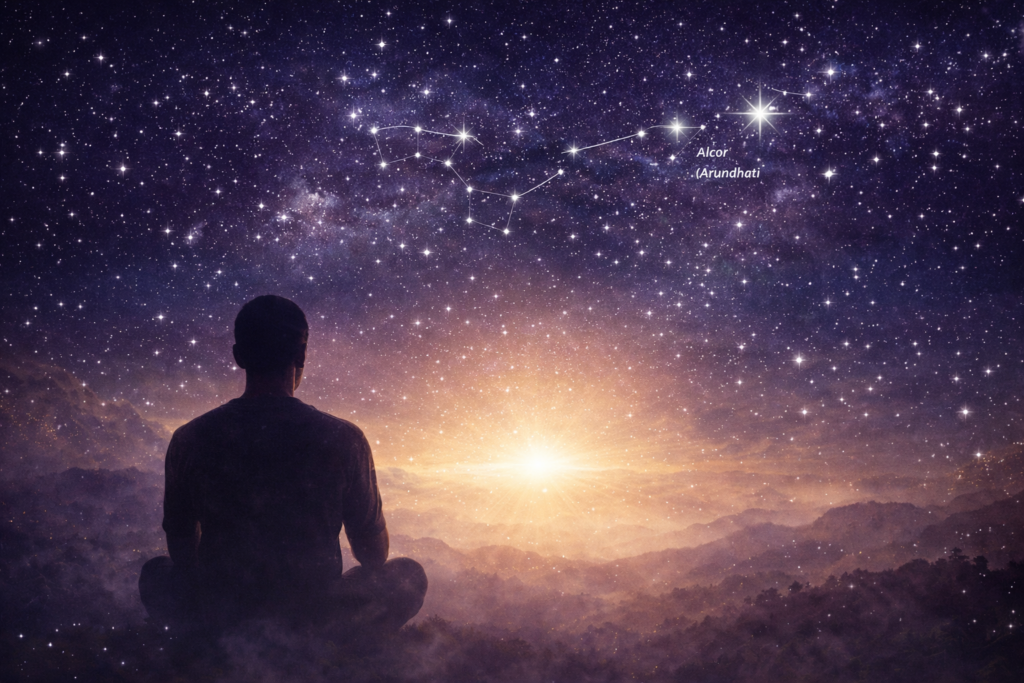
Recently, I attended a Wisdom Night at Mantra Lounge facilitated by Pavani Devi where we explored a simple yet profound question inspired by the Bhagavad Gita:
Who am I?
At first, the answer feels obvious. We tend to identify with our body, our thoughts, our emotions, and the roles we play in life. But the session gently challenged this assumption.
From the Obvious to the Subtle
To help us understand this, Pavani introduced the example of the Arundhati star. This is a faint star that cannot be seen directly without guidance. One must first locate brighter, more obvious stars, and then gradually refine their focus to perceive the subtle.
In the same way, the Vedic teachings guide us step by step—from what is visible and familiar to what is subtle and ultimately true. We are not expected to immediately grasp the deepest truth; we can be led towards it gradually.
Understanding the Layers of the Self
A key insight from the session was that we exist in layers:
- The gross body — our physical form
- The subtle body — the mind, intelligence, and false ego
- The soul (Ātma) — conscious the observer
While the body and mind are constantly changing, the soul remains steady—the one that observes all experiences.
If we are not the body, then why do we feel pain and sadness so deeply?
The Driver and the Car
The above question was answered using the race car driver analogy. Sitting in a tight cockpit, fully connected to the car, the driver feels every vibration—every turn, every bump, even the smallest pebble on the road. Yet, despite experiencing all of this, the driver is not the car.
Similarly, we are deeply connected to our body and mind, which is why we feel physical pain and emotional highs and lows so intensely. But that does not mean we are those experiences.
Pain, Emotions, and the Subtle Body
The session also touched on how the subtle body stores our thoughts, beliefs, stress, and even past trauma. Over time, these inner experiences can manifest in the physical body.
This helped me understand that what we feel is real—but it does not define who we are. Through awareness and observation, we can begin to create a sense of space between ourselves and our experiences.
✨ The Nature of the Soul
The soul is described as Sat–Cit–Ānanda—eternal, full of knowledge, and blissful.
This means that at our core, we are not defined by fear, confusion, or suffering. Our true nature is steady, aware, and peaceful. However, this is often covered by our identification with the body and mind.
A Journey Towards Purpose
Understanding who we are is not just a philosophical idea—it’s the foundation for discovering our dharma, our purpose and natural way of living.
When we begin to see ourselves as the observer rather than the body or mind, our perspective shifts. We start to act with more clarity, intention, and alignment.
What Comes Next?
We were left with a powerful thought:
If I am not the body or the mind, but the soul—
then what is my purpose? How should I live?
Stay tuned for the next blog post as we explore this further in the upcoming session.
– Siroumi